


A Fresh Guide for Readers, Writers & Afrofuturism Lovers
The world is finally paying attention to African storytellers—and sci-fi is one of the fastest rising genres on the continent. It’s exploding across the internet.
From the global success of Afrofuturism aesthetics on TikTok to the rise of African creators on YouTube breaking down speculative stories and the popularity of African folklore-inspired games, the world is finally turning its eyes toward stories shaped by African imagination.
Readers want futuristic Africa, myth-tech mashups, ancestral magic meeting AI, and worlds where the continent is not the future—it creates the future.
If you’re a writer, reader, or creator looking for inspiration, these 10 African sci-fi authors will open your mind to the kind of stories only Africa can imagine.
Let’s dive in.
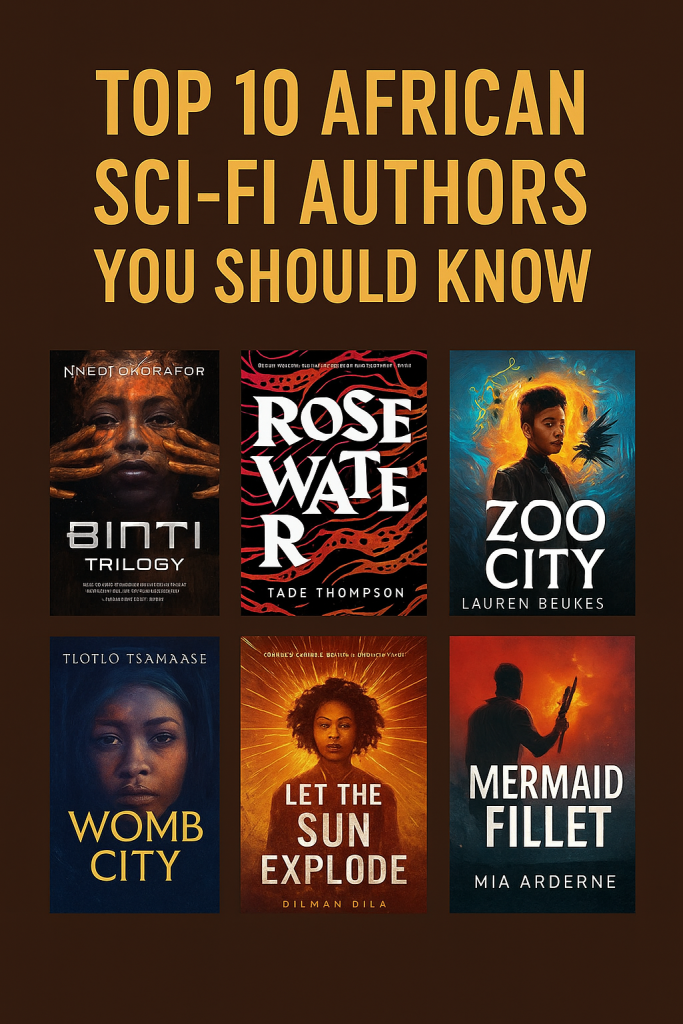
1. Nnedi Okorafor (Nigeria/US)
Title/Book: Binti Trilogy, Who Fears Death
Nnedi Okorafor is a Nigerian-American author whose imagination rewrites what sci-fi can look like. She blends Igbo culture, mythology, and real-world politics with futuristic worlds.
From her book: Binti explores what happens when a gifted Himba girl becomes the first of her people to journey across the galaxy—carrying culture through space.
For beginner writers:
Nnedi shows that your everyday culture—hairstyles, rituals, languages—can become the core science of your sci-fi world.
2. Tade Thompson (Nigeria/UK)
Title/Book: Rosewater
Tade Thompson builds complex, mind-bending sci-fi worlds rooted in African cities and political landscapes.
A short feel from his world:
He pictured Lagos, where a giant alien dome grows like a living organism, and people gain psychic abilities they never asked for. A futuristic Nigeria where alien technology transforms society—and not always for the better.
For beginner writers:
He proves sci-fi can include crime, mystery, politics, and survival, not just spaceships.
3. Lauren Beukes (South Africa)
Title/Book: Zoo City
Lauren Beukes mixes dystopian sci-fi with gritty African urban life.
From her book, Zoo City introduces a Johannesburg where people magically grow animal companions tied to their guilt (guilt becomes a physical animal that attaches itself to you—following you everywhere).
Why Readers Connect:
She shows how to make African cities feel alive, dangerous, magical, and futuristic all at once. Also, your city’s struggles and beauty are enough to build a thrilling sci-fi universe.
4. Suyi Davies Okungbowa (Nigeria)
Title/Book: Lost Ark Dreaming
Suyi writes bold, layered African futurism exploring migration, power, and identity.
From his book: Lost Ark Dreaming imagines future Lagos underwater—with survivors building new societies above the floodline.
Why beginners learn from him:
He’s great at using real African challenges (floods, inequality, urban growth) to build believable futures.
5. Tlotlo Tsamaase (Botswana)
Title/Book: Womb City
Tlotlo brings a dark, poetic style to African speculative fiction.
From her book: Womb City explores body horror, government control, and identity in a high-tech future Botswana. A society where bodies can be borrowed, traded, and punished—and a woman fights to keep control of her own.
Why She’s Unique:
She teaches writers how to blend technology with psychological depth.
She proves sci-fi can be bold, unsettling, feminist, and deeply African.
6. Shingai Njeri Kagunda (Kenya)
Book Title: And This Is How to Stay Alive / Let the Star Explode
From her book: A brother dies, and time bends for his sibling—letting them rewrite a moment that refuses to stay in the past.
She uses time loops to explore grief, family, generational trauma, and healing.
What Writers Can Learn:
How to create sci-fi that feels spiritual and intimate, not just futuristic.
7. Dilman Dila (Uganda)
Book Title: A Killing in the Sun
Why he matters:
Dilman is one of East Africa’s most experimental sci-fi voices. His stories weave African mythology with futuristic imagination
From his book:
He explores war, folklore, robots, spirits, and social injustice with haunting simplicity.
Beginner-friendly lesson:
Simple writing. Big ideas. Deep emotion—a winning formula
8. Mia Arderne (South Africa)
Book Title: Mermaid Filled
From her book:
She mixes mythology with gritty Cape Town realities to create a world that’s intense, funny, and painfully real. A neon-lit Cape Town where mermaids aren’t fairy tales—they’re a warning.
Why She’s Important:
She reminds writers that African sci-fi doesn’t need to be “clean”—it can be chaotic and raw.
For beginner writers:
She teaches that sci-fi can be fearless, messy, street-smart, and deeply honest.
9. Farai Mudzingwa (Zimbabwe)
Book Title: Avenues by Train
Why he matters:
Farai brings psychological depth to speculative fiction, exploring trauma, memory, and destiny.
A short feel from his world:
A boy grows up navigating both real violence and the invisible forces that haunt his past.
For beginner writers:
Farai shows how sci-fi can be quiet, reflective, and rooted in human struggle.
10. Nkone Chaka (South Africa)
Book Title: To Eat Your Own Head
Why she matters:
Nkone writes experimental, surreal sci-fi that pushes boundaries.
A short feel from her world:
A universe where identity splits, reforms, and eats itself—challenging everything you believe about being alive.
For beginner writers:
She inspires writers to break the rules and trust strange ideas.
Why These Authors Matter Right Now
They are reshaping global sci-fi from Africa outward.
- Hollywood, Netflix, and global publishers are actively scouting African futurism.
- Their books prove African writers don’t need to imitate Western sci-fi.
- They create stories where African culture leads—not follows.
Conclusion
African sci-fi is not the future—it is the now, and it is shaping global imagination like never before.
If you’re a writer or a reader, dive into these creators’ worlds and let their brilliance inspire your own storytelling.
And if you’re ready to write your own sci-fi masterpiece,
Bukkie Allison Consulting is here to guide your journey.
Written by Patience Cyril Iwuoha
Content Writer, BAC Growth Intern